

FANGGEKARSPITZE ON THE ARLBERG
FREERIDE TOUR WITH OUR ATHLETES SIMON AND LENA
It’s not easy to leave new tracks on the Arlberg. It’s anything but virgin terrain. The cradle of skiing, the home of ski bums. “But if you approach it a different way, there is still a lot to discover,” says Simon. “For me, it’s not about the steepest, the highest, the longest descent or about collecting vertical meters. What drives me is curiosity, exploration and the idea of leaving special tracks.”

MEET SIMON AND LENA
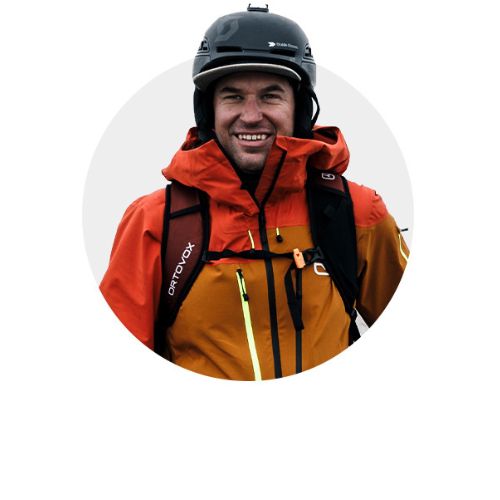
Simon Wohlgenannt is a freeride guide, ski guide and state-certified ski trainer, he recently became an author and is a patient person. He knows the Arlberg well. Very well. But the north gully of the 2,640-meter Fanggekarspitze remains elusive. “It’s a fascinating mountain with a very cool slope. I’ve so often looked at it and asked myself whether there’s a way down into the northern gully over the exposed ramp at the top, and if you could ski all the way down in one go.” As a trained biologist with a thoughtful approach to nature, Simon knows that if you want to live long and become an old freerider, you have to know your limits. Personal limits, conservation limits, and natural limits. That's why Simon teamed up with fellow freerider and aspiring mountain guide Lena Koller in the winter of 2023 to tackle the Fanggerkarspitze project together.
WHY IS THE FANGGEKARSPItZE SO SPECIAL?
The Fanggekarspitze isn’t an Arlberg classic. It’s not a gleaming massif like the Rote Wand, or an icon like Valluga. Maybe that’s precisely why it’s so tempting to local freerider Simon Wohlgenannt. He has observed and studied it for a long time and slowly got closer and closer before making his tracks on its slopes. “For special projects you need to have a great deal of knowledge and, above all, a great deal of patience. It could take years for the right moment and the right conditions to come along. The Fanggekarspitze can be skied on maybe just five days in the season.” The 39-year-old says that the north-facing slopes are actually unskiable in the height of winter. “There are so many layers in the snowpack that it’s very difficult to tell whether it will hold. The steep slope season in the Arlberg is actually in March/April, when the snow has melted through after periods of warmth “and another 10cm of snow has fallen on top, then you’ve got fantastic conditions.”


The Path to the Fanggekarspitze
But 2023 once again has a “strange season”, with an April that’s wintrier than the winter. Instead of the usual 10cm, 75cm of new snow falls. Simon does a lot of conferring with the team he put together for this project: fellow freerider and aspiring mountain guide Lena Koller, videographer Fabian Spindler and photographer Max Draeger. They decide to take a slow approach to the Fanggekarspitze.
One reason it’s slow is because Simon is cycling from his front door to the Arlberg, “which is another way to take a new path.” Together, the crew ascends and starts by skiing “a few gentle slopes around the Rüfispitze to assess the snowpack.” “We continuously increased the slope steepness and finally came to the Erlispitze, carried out a snow profile and then descended against the backdrop of a spectacular sunset.”
The Stuttgarter Hütte serves as their base camp. With no sleeping bags, their night in the winter room is cold – and short. They start early in the morning. And out into the clouds. The crew is tense. “It didn’t look good, but we were lucky and the sun broke through just before we reached the summit of the Fanggekarspitze. That meant we could see that we could ski over the ramp and a short steep section directly into a continuous gully – narrow, steep and exciting.” The beginning is a dream. The extremely steep start just next to the rock faces offers the finest powder. But the second section gets “tough and technically quite difficult”. The sun has been burning down onto the snow for too long – and now their thighs are burning too.
They make four tracks on the slope. They don’t stay visible for long. But they’re firmly engraved on the memories of the four freeriders. Our brains gives higher priority to memorizing new experiences. This trip is an experience that will remain with them forever. And so is the search for new paths.
Tour facts
- type: freeride
- Duration: 2 days
- Ascent:
- day 1: 1245 m biking and 1950 m skiing (1200 m with lift and bus support)
- day 2: 700 m
- Difficulty: very difficult